


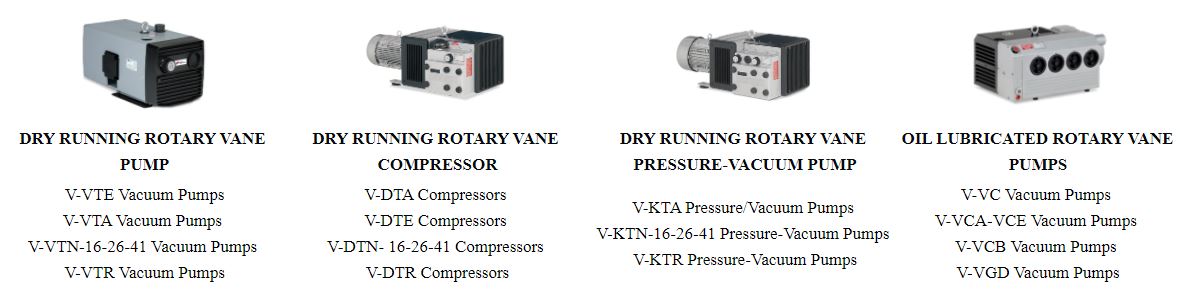
Dry running and oil-lubricated vane pumps are used across many fields and a wide range of duties. The environmentally friendly dry running vane pump is used for vacuum, pressure and combined pressure applications.
The V-Series from Elmo Rietschle - a Gardner Denver brand
1. Advantages of the rotary vane vacuum pump
- Dry running and oil-lubricated versions
- Low noise
- Powerful and economical
- Long service life
- Easy to operate
- Easy to maintain
- Low oil consumption on oil-lubricated machines
2. Air flow chart

Figure 1: Air flow chart for the rotary vane vacuum pump
3. How the rotary vane vacuum pump works
3.1 Dry running rotary vane vacuum pump
Raising pressure by reducing volume is the working principle of the rotary vane; this design responds well in pressure, vacuum or a combination of both.
Inside a cylindrical housing, the rotor is mounted eccentrically so that at the top it almost touches the cylinder. The vanes sit inside slots in the rotor.
When the rotor starts to turn, centrifugal force throws the vanes outwards so they slide against the inner surface of the cylinder. In this way a cell is formed between two vanes whose volume changes continuously during rotation. Air enters from the inlet port into a cell until the trailing vane reaches the inlet port. At this point the maximum quantity of air has been taken in. As the cell moves away from the port its volume becomes ever smaller, so the air is compressed and the pressure rises.
This continues until the pressure in the cell exceeds the pressure in the pressure chamber, at which point the compressed air escapes through the outlet port.
Some models are fitted with a discharge valve that prevents backflow of the exhausted air once maximum pressure has been reached. In a vacuum pump the process is the same, but for falling pressure, with the chamber at atmospheric pressure.
On a pressure-vacuum pump, the lower end of the inlet port for vacuum is moved forward. The cells can now be filled through a second inlet. To avoid spoiling the vacuum, this second inlet is placed about one cell away from the main suction port. The ratio between vacuum and pressure capacity can be influenced by the choice of inlet port.

Figure 2: Principle of the dry running rotary vane vacuum pump
3.2 How the oil-lubricated rotary vane vacuum pump works
Raising pressure by reducing volume is the working principle of the rotary vane. This design responds well for pressure, vacuum or a combination of both. Inside a cylindrical housing the rotor is mounted eccentrically so that at the top it almost touches the cylinder. The vanes sit inside the rotor slots. When the rotor starts to turn, centrifugal force throws the vanes outwards so they slide against the inner surface of the cylinder.
In this way a cell is formed between two vanes whose volume changes continuously during rotation. Air enters from the inlet port into a cell until the trailing vane reaches the inlet port. At this point the maximum quantity of air has been taken in.
As the cell moves away from the port its volume becomes ever smaller, so the air is compressed and the pressure rises. Some models are fitted with an outlet valve next to the outlet port to prevent the exhaust gas flowing back once maximum pressure has been reached.
After passing through the outlet port and the outlet valve, the oil-air mixture reaches the oil separation chamber, where the oil is separated from the gas in two steps. Larger oil droplets are separated from the gas mechanically and finally settle in the oil sump.
The remaining oil-gas mixture is then passed through fine filter elements to separate the smallest oil particles. These are then returned through an oil scavenge line into the pump's oil circuit. The virtually oil-free gas can be discharged outside through the gas outlet, via the ducting provided or other pipework.
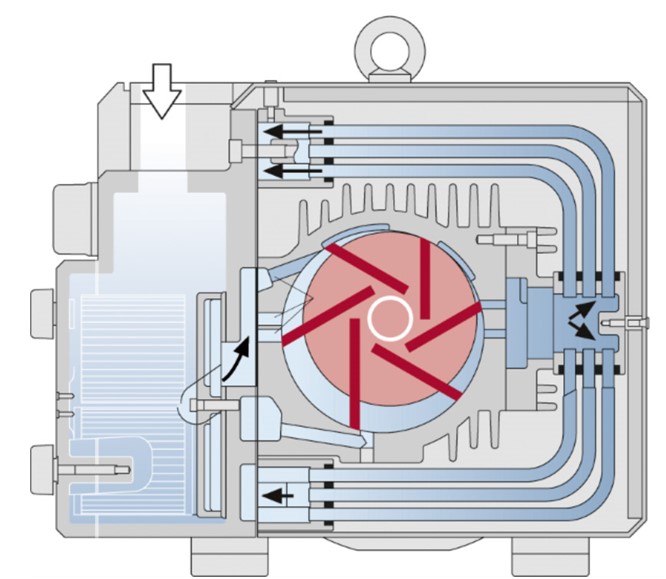
Figure 3: Principle of the oil-lubricated rotary vane vacuum pump
See AVA's other vacuum pump ranges HERE:

Contact AVA for advice and help buying genuine products at the best price.
- PHONE : + 84 28 3620 4172
- HOTLINE :0909790869
- EMAIL: tuong.nguyen@airvacuum.com.vn